Tuesday, August 23, 2011

Gold entering correction


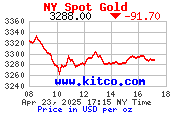
Gold entering correction, I am short as of this afternoon. Look to add new longs at 1650. Careful with the miners, the stock market is putting in a short-term bottom but gold is putting in an intermediate-term top. The miners may end up being false-breakouts, or rather probably pre-mature breakouts.

Wednesday, May 18, 2011

Silver Topped? I don't think so


The first chart is a collection of different market surveys compiled to gain a perspective about the public opinion of Silver. Clearly the public has gone from bullish euphoria to bearish gloom and doom as regards the shiny white metal. Chart as of May 17, 2011

The second chart shows the commitment of traders (COT) of silver futures speculators. (All open and outstanding positions, Commercials+Large Speculators+Small Speculators=0)The Commercials have been rapidly covering their shorts and the large speculators liquidating their longs. Chart from May 13, 2011

A quick glance will show both charts setting up for another leg higher in silver.

Maybe the title for this post should be Silver topped? Not a Chance!

Monday, June 28, 2010

Average Age Of Exxon Valdez Worker: 51 Years


Considering there is no end in site to the oil volcano, parts of the gulf coast have a strong probability of becoming uninhabitable. Seeing as the majority of oil refineries in the U.S. are found in the area this situation is getting worse every day.

Friday, June 25, 2010

Pensacola Beach Boiling


Prepare for likely mass diaspora from the gulf (according to Matt Simmons)

Tuesday, June 15, 2010

Starting To Lose Faith In General Public

This doesn't even justify a response

Currency Collapse May Stimulate Economic Expansion, BIS Says


June 14 (Bloomberg) -- Currency collapses tend to spur a resumption of economic growth rather than fueling a decline in gross domestic product, according to the Bank for International Settlements.

Currency collapses are associated with permanent output losses of about 6 percent of GDP, on average, though the drop tends to appear beforehand, the Basel, Switzerland-based BIS said in its quarterly review yesterday.

“This suggests that it may not be the currency collapse that reduces output, but rather the factors that led to the depreciation,” Camilo E. Tovar wrote in the study. “To gain a full understanding of the implications of currency collapses on economic activity it is important to carefully examine the full circle of events surrounding the episode.”

The positive effects of a weaker currency on GDP, including making local products cheaper than imported goods, may outweigh the negative ones, such as rising inflation. Currency collapses occur when the annual exchange rate drops by about 22 percent, according to the BIS, which identified 79 such episodes, “more commonly in Africa than in Asia or Latin America,” since 1960, Tovar said.

“They also occurred under all types of currency regimes, except possible floating-exchange-rate regimes, where there are simply too few observations to obtain meaningful estimates,” the BIS said.

Economic Contraction

The euro tumbled about 20 percent against the dollar between Nov. 25, 2009, and last week as investor concern over record budget deficits in countries including Greece spurred speculation the 16-nation currency union may split. The European Union in May crafted a 750 billion-euro ($908 billion) rescue package to stem the crisis.

Greece’s economy will contract 3.9 percent this year and 1.2 percent in 2011, after shrinking 2 percent in 2009, according to the median of eight economist estimates compiled by Bloomberg. The euro-region will expand by 1.1 percent this year and 1.5 percent in 2011, after falling 4.1 percent last year, median forecasts show.

Hans-Werner Sinn, president of Germany’s Ifo economic institute, said on June 3 that it would be best for Greece to leave the euro instead of implementing an austerity program to reduce its deficit. Greek Prime Minister George Papandreou pledged budget cuts worth almost 14 percent of GDP to bring the deficit within the EU limit of 3 percent by the end of 2014.

“The real solution for Greece would be to leave the euro followed by a depreciation” of the new currency, Sinn said in an interview at a conference in Interlaken, Switzerland.

Growth May ‘Dominate’

European Central Bank Executive Board member Lorenzo Bini Smaghi said on May 28 that there are “no alternatives” for Greece beyond following the austerity program.

“Before drawing policy conclusions we should emphasise that these results are subject to a number of caveats,” the BIS said in the report. “Most importantly, the analysis does not address the reasons why currency collapses occur in the first place. Our analysis also has little to say about the mechanisms involved after the currency collapse takes place. While we cannot disentangle the various factors, our results do suggest that expansionary mechanisms tend to dominate.”

Wednesday, June 9, 2010

EPA: Amish Farming Bad For Environment

Only in Barry Soetoro's America

Amish Farming Draws Rare Government Scrutiny


LANCASTER, Pa. — With simplicity as their credo, Amish farmers consume so little that some might consider them model environmental citizens.

“We are supposed to be stewards of the land,” said Matthew Stoltzfus, a 34-year-old dairy farmer and father of seven whose family, like many other Amish, shuns cars in favor of horse and buggy and lives without electricity. “It is our Christian duty.”

But farmers like Mr. Stoltzfus are facing growing scrutiny for agricultural practices that the federal government sees as environmentally destructive. Their cows generate heaps of manure that easily washes into streams and flows onward into the Chesapeake Bay.

And the Environmental Protection Agency, charged by President Obama with restoring the bay to health, is determined to crack down. The farmers have a choice: change the way they farm or face stiff penalties.

“There’s much, much work that needs to be done, and I don’t think the full community understands,” said David McGuigan, the E.P.A. official leading an effort by the agency to change farming practices here in Lancaster County.

Runoff from manure and synthetic fertilizers has polluted the Chesapeake Bay for years, reducing oxygen rates, killing fish and creating a dead zone that has persisted since the 1970s despite off-and-on cleanup efforts. But of the dozens of counties that contribute to the deadly runoff of nitrogen and phosphorus, Lancaster ranks at the top. According to E.P.A. data from 2007, the most recent available, the county generates more than 61 million pounds of manure a year. That is 20 million pounds more than the next highest county on the list of bay polluters, and more than six times that of most other counties.

The challenge for the environmental agency is to steer the farmers toward new practices without stirring resentment that might cause a backlash. The so-called plain-sect families — Amish and Old Order Mennonites, descended from persecuted Anabaptists who fled Germany and Switzerland in the 1700s — are notoriously wary of outsiders and of the government in particular.

Best Buy Sized Bars - ESPN Zone - To Close

The good old days are gone folks - and they are not coming back. Palatial, mahagony & marble bars are going to be replaced with corner dives that serve dollar Pabst Blue Ribbons.

Disney Said to Be Closing Most of Its ESPN Zone Restaurants

The sports-themed restaurants operate in seven cities, including L.A. and Las Vegas. The Anaheim outlet is expected to remain open.

Walt Disney Co. is shutting down most of its ESPN Zone stores, a chain of sports-themed restaurants in seven cities, according to a person familiar with the matter. The only outlets to remain open are those tied to a Disney property, such as the Downtown Disney shopping district in Anaheim.

ESPN Zone opened in 1998 to capitalize on ESPN's brand, while bringing Disney's family-friendly atmosphere to the sports bar concept. The upscale eateries serve burgers and brews as walls of big-screen TVs beam baseball and other sporting events into the dining area. Separate gaming rooms, dubbed "Sports Arenas," provide access to interactive games, such as virtual golf and boxing.

It's unclear what has prompted Disney to close the establishments, although the bars may well be a casualty of the recession. A poll released in March by AlixPartners found that 30% of consumers planned to eat out less frequently, and spend less per meal than they did the year before.

In addition, some of the ESPN Zone restaurants are in high-priced real estate areas, such as Times Square in New York.

"Since their inception, the Zones have served sports fans very well," said an ESPN spokesman, who declined to comment further. "But from a pure business perspective, the economics have been challenging."

Harry Balzer, chief industry analyst for research firm NPD Group, said the restaurant business was undergoing its biggest decline in three decades.

"This year was horrible," Balzer said. "A restaurant meal is a very discretionary behavior. You could always eat at home and save money doing it. And going out for dinner is the most expensive food you could buy."

Balzer said casual-dining restaurants like ESPN Zone have been among the hardest hit, as consumers gravitate to less expensive chains such as Chipotle Mexican Grill or Panera Bread, which offer sit-down dining at fast-food prices. ESPN may also have suffered from the problem that afflicted Planet Hollywood, which closed several restaurants — the novelty simply wore off, he said.

In addition to Anaheim, Disney operates ESPN Zone restaurants in Baltimore, Chicago, Las Vegas, New York and Washington. The company also licenses the ESPN Zone brand to a restaurant at the L.A. Live shopping and entertainment complex in downtown Los Angeles. It's unclear whether that location will remain open. Disney closed the Atlanta and Denver locations last year.

Tuesday, June 8, 2010

Celente: Fascism Has Come To America

Buy Guns, Barbed Wire: Advisor


I'll throw in freeze dried food as well. Considering the magnitude (and ineptitude)
of the oil spill - there will certainly be an impact on crops grown in the southeast. Throw in the already blistering inflation rate of food items with the certainty of future inflationary pressures and you have a volatile situation.

Costco offers a well rounded bucket for $74.99: Emergency Food Supply

Markets About To Turn Nasty: Buy Barbed Wire, Advisor

Bond markets could get very nasty over the coming months, while stock investors could take a few months off and stop attempting to trade volatile swings in the markets, Anthony Fry, senior managing director at Evercore Partners, told CNBC Monday.

“The current problems will be with us for 5 years or more and uncertainty is very high," Fry said.

"Sentiment is extremely volatile as shown by the collapse of the Prudential’s attempt to buy AIA. When the deal was thought up just a few months ago it was a very different world,” Fry told CNBC on Monday.

Fry says the best we can hope for in the current environment is a soft landing, but sees little chance of this happening.

“Look at the current situation. You have Greece, now you have Hungary and huge issues surrounding Spain and Portugal,” he said.

Fry believes many European banks have yet to fess up on losses and says governments across the world are between a rock and a hard place.

“Governments need to cut spending and raise money and if they do not do so credibly will be killed by the bond market demanding higher rates,” he said.

No Exit Strategy

Fry sees three outcomes for the global economy and none of them makes very good reading.

“You can have lower rates and deflation, higher rates and higher inflation or the nightmare scenario of higher rates and deflating asset prices,” he said.

“If the nightmare scenario plays out as I suspect it may then the debt situation gets worse. There is currently no exit strategy and the reaction to the crisis of policy makers remains a big worry.”

As a result, Fry is telling investors to play it safe and buy physical assets like land.

“I don’t want to scare anyone but I am considering investing in barbed wire and guns, things are not looking good and rates are heading higher,” he said.

The comments mirror those of bearish Bob Janjuah from RBS, who told CNBC on Friday that we are facing big stock market losses and told investors to get into gold before G20 governments attempt to throw another $15 trillion in quantitative easing in a bid to jump start the economy.

“The policymakers' response to the crisis has been new debt and this is an old game” said Janjuah.

“Over the next 6 months we will see private sector deflation pushing 10-year yields down to 2 percent," he predicted.

"This will see the policy makers mistakenly attempt to kick start the economy and market with a global quantitative easing program worth between $10 and $15 trillion dollars.”

Wednesday, June 2, 2010

Oil Spill Not Going Away

North Korea, Iran, Israel Vs. Turkey - the real pressing issue for the US is the evolving mega disaster in the Gulf of Mexico. With a best case scenario of the oil volcano being plugged in the fourth quarter of 2010, the air in and around the gulf will become multiple times more toxic and potentially force mass evacuations should the methane gas make landfall. According to the Cleveland Leader, some beach goers are already falling ill simply by going near the water.

Workers Hired To Help Cleanup Oil Spill Are Falling Ill

Fisherman and others hired by BP to help save the Gulf have been hospitalized in increasing number with nausea, high blood pressure and pounding headaches. They blame the oil giant and the chemical they have been pouring in the Gulf of Mexico to help disperse the growing oil slick.

Some of those sick workers are now suing BP and Transocean, the owners of the Deepwater Horizon oil rig that exploded in late April.

Entire crews have gotten ill after coming into contact with the dispersant, Corexit, which is supposed to break up the oil into small droplets that are biodegradable. According to the company that makes the chemical, it's safe. The federal government, however, has asked that BP limit its use.

But it's not just the workers who are getting sick. Some beach-goers are even reporting illness after being just near the water.

Wednesday, May 19, 2010

Russell: You Won't Recognize America By The End of The Year

As the financial clouds on the horizon darken, we continue to hear warnings of an approaching crises.

So who is Richard Russell ?

Russell began publishing Dow Theory Letters in 1958, and he has been writing the Letters ever since (never once having skipped a Letter). Dow Theory Letters is the oldest service continuously written by one person in the business.

Russell gained wide recognition via a series of over 30 Dow Theory and technical articles that he wrote for Barron's during the late-'50s through the '90s. Through Barron's and via word of mouth, he gained a wide following. Russell was the first (in 1960) to recommend gold stocks. He called the top of the 1949-'66 bull market. And almost to the day he called the bottom of the great 1972-'74 bear market, and the beginning of the great bull market which started in December 1974.

The Letters, published every three weeks, cover the US stock market, foreign markets, bonds, precious metals, commodities, economics --plus Russell's widely-followed comments and observations and stock market philosophy.

In 1989 Russell took over Julian Snyder's well-known advisory service, "International Moneyline", a service which Mr. Synder ran from Switzerland. Then, in 1998 Russell took over the Zweig Forecast from famed market analyst, Martin Zweig. Russell has written articles and been quoted in such publications as Bloomberg magazine, Barron's, Time, Newsweek, Money Magazine, the Wall Street Journal, the New York Times, Reuters, and others. Subscribers to Dow Theory Letters number over 12,000, hailing from all 50 states and dozens of overseas counties.

A native New Yorker (born in 1924) Russell has lived through depressions and booms, through good times and bad, through war and peace. He was educated at Rutgers and received his BA at NYU. Russell flew as a combat bombardier on B-25 Mitchell Bombers with the 12th Air Force during World War II.

One of the favorite features of the Letter is Russell's daily Primary Trend Index (PTI), which is a proprietary index which has been included in the Letters since 1971. The PTI has been an amazingly accurate and useful guide to the trend of the market, and it often actually differs with Russell's opinions. But Russell always defers to his PTI. Says Russell, "The PTI is a lot smarter than I am. It's a great ego-deflator, as far as I'm concerned, and I've learned never to fight it."


Dow Theorist Richard Russell: Sell Everything Liquid, You Won't Recognize America By Year's End

WHOA!

Richard Russell, the famous writer of the Dow Theory Letters, has a chilling line in today's note:

Do your friends a favor. Tell them to "batten down the hatches" because there's a HARD RAIN coming. Tell them to get out of debt and sell anything they can sell (and don't need) in order to get liquid. Tell them that Richard Russell says that by the end of this year they won't recognize the country. They'll retort, "How the dickens does Russell know -- who told him?" Tell them the stock market told him.

That's pretty intense!

Update: By popular demand, here's more on what he sees in the market. The gist is that the markets recent gyrations are telling him that the economy is in trouble:

And I ask myself, "Am I seeing things? The April 26 high for the Dow
was 11205.03. The Dow is selling as write at 10557 down 648 points
from its April high. If business is even better than expected, then
why is the Dow down over 600 points? And why, if there were 674 new
highs on the NYSE on April 26, were there only 20 new highs on Friday,
May 14? And if my PTI was 6133 on April 26, why is it down 17 points
since its April high?

The fact is that I've been seeing deterioration in the stock market
ever since early-April, and this in the face of improving business
news. The D-J Industrial Average is composed of 30 internationally
known top-quality blue-chip stocks. These are 30 of "America's biggest
companies." If Barron's is so bullish on the future of America's
biggest companies, then why isn't the Dow advancing to new highs?

Clearly something is wrong. But what could it be? Much as I love
Barron's, I trust the stock market more. If I read the stock market
correctly, it's telling me that there is a surprise ahead. And that
surprise will be a reversal to the downside for the economy, plus a
collection of other troubles ahead.

About Dow Theory -- First, we saw the recent April highs in the
Averages. Then we saw a plunge in both Averages to their May 7 lows --
Industrials to 10380.43, Transports to 4298.12, next a short rally. If
ahead, the two Averages turn down and violate their May 7 lows, that
would be the clincher. Such action would signal the certain resumption
of the primary bear market.

Just as for years I asked, cajoled, insisted, threatened, demanded,
that my subscribers buy gold, I am now insisting, demanding, begging
my subscribers to get OUT of stocks (including C and BYD, but not
including golds) and get into cash or gold (bullion if possible). If
the two Averages violate their May 7 lows, I see a major crash as the
outcome. Pul - leeze, get out of stocks now, and I don't give a damn
whether you have paper losses or paper profits!

Read more: http://www.businessinsider.com/dow-theorist-richard-russell-sell-everything-liquid-you-wont-recognize-america-by-the-end-of-the-year-2010-5#ixzz0oNglP8DO

Tuesday, May 18, 2010

GM Has No Shame

If you aren't convinced the next downturn will be a showstopper, take a look at the article below where GM is seeking leniency in loaning to sub prime buyers. Simply shocking.

GM Wants More Subprime Customers Approved For Auto Loans

General Motors, looking to boost sales and gain customers, wants to give more auto loans to consumers with bad credit. But without its own captive lending arm, it is losing customers to other automakers, who are more willing to take on the risk of approving an auto loan to a customer with less-than-perfect credit.

GM's top North American executive Mark Reuss said a shortage of subprime lending is holding back sales in the U.S., the AP reports. GM sold most of its former auto finance unit, GMAC (now called Ally), in 2006.

Ally provides consumer auto loans not only for GM, but for Chrysler, along with dealer floor plan financing. Therefore, Ally, not GM or Chrysler, decides who gets a car loan. If GM decides to try and buy back its stake in Ally or start its own finance arm, it can decide who to give car loans to.

And since Ally lost money in the mortgage crisis, it is nervous to lend money to car shoppers with bad credit. GM knows that bad credit car loans are a good source of profit, since the interest rates tend to be very high at about 10 to 20 percent.

According to Experian automotive, about 16 percent of all new-vehicle loans approved in the fourth quarter of 2009 were to customers with non-prime credit (those with credit scores below 620).

Monday, May 17, 2010

U.K. Broke as Joke

"There's No Money Left" = the last lifeboat has left the Titanic

'There's No Money Left,' U.K. Minister Learns

May 17 (Bloomberg) -- Arriving for work at the U.K. Treasury last week, the incoming chief secretary, David Laws, found a note from his predecessor, Liam Byrne, offering advice on the job.

“Dear Chief Secretary, I’m afraid to tell you there’s no money left,” Laws cited it as saying.

“Which was honest,” Laws, whose position is the No. 2 in the Treasury after the chancellor of the exchequer, told a press conference in London today. “But slightly less than I was expecting.”

The note underscores the task facing Britain’s Conservative-Liberal Democrat coalition as it seeks to reconcile demand for improved health and education services with promises to reduce the largest budget deficit since World War II.

It was also in the tradition of Reginald Maudling, Conservative chancellor of the exchequer from 1962 to 1964. Leaving his residence after election defeat, he was reported byJames Callaghan, his successor, to have remarked, “Sorry, old cock, to leave it in this shape.”

Byrne didn’t respond to requests for comment. He was quoted by Sky News as saying the note was a joke. “I do hope David Laws’ sense of humour wasn’t another casualty of the coalition deal,” he said, according to Sky News.

According to the Treasury, the letter read as follows: “Dear Chief Secretary, I’m afraid there’s no money. Kind regards -- and good luck! Liam.”

Sunday, May 16, 2010

More Than Meets The Eye

Scientists are finding enormous oil plumes in the deep waters of the Gulf of Mexico, including one as large as 10 miles long, 3 miles wide and 300 feet thick in spots. The discovery is fresh evidence that the leak from the broken undersea well could be substantially worse than estimates that the government and BP have given.

The environmental, economic and international impact of this catastrophe cannot be understated. This new information indicates the initial spill numbers were lowballed and some estimates indicate that the oil volcano spews off the equivalent of an Exxon Valdez like spill every 4 days.

Giant Plumes of Oil Forming Under The Gulf

Scientists are finding enormous oil plumes in the deep waters of the Gulf of Mexico, including one as large as 10 miles long, 3 miles wide and 300 feet thick in spots. The discovery is fresh evidence that the leak from the broken undersea well could be substantially worse than estimates that the government and BP have given.

“There’s a shocking amount of oil in the deep water, relative to what you see in the surface water,” said Samantha Joye, a researcher at the University of Georgia who is involved in one of the first scientific missions to gather details about what is happening in the gulf. “There’s a tremendous amount of oil in multiple layers, three or four or five layers deep in the water column.”

The plumes are depleting the oxygen dissolved in the gulf, worrying scientists, who fear that the oxygen level could eventually fall so low as to kill off much of the sea life near the plumes.

Dr. Joye said the oxygen had already dropped 30 percent near some of the plumes in the month that the broken oil well had been flowing. “If you keep those kinds of rates up, you could draw the oxygen down to very low levels that are dangerous to animals in a couple of months,” she said Saturday. “That is alarming.”

The plumes were discovered by scientists from several universities working aboard the research vessel Pelican, which sailed from Cocodrie, La., on May 3 and has gathered extensive samples and information about the disaster in the gulf.

Thursday, May 13, 2010

ATMs That Dispense Real Money

Ireland Boiling Over


Countries with north of 20% unemployment and 50% or more for those 18-25 are in for some major problems.

Greek Debt Contagion

Greek Debt Crisis--The Preview of What is to Come 5-6-10

The Illusion of Market Health

Commercial real estate has been overrun by wildcat charlatans that have leveraged themselves out of their assets. Their is used lightly as equity positions by major players is typically 1-5%...AT MOST. Let's call them group C and get to them in a moment.

Institutional commercial real estate is completely dominated by pension funds and sovereign wealth with a bit of independent wealth funds thrown in for good measure. Groups like CALPERS, CALSTERS, MRPT, China Investment Corporation and Singapore Investment Corporation controll the lion's share of equity in the market. This is what we call group A.

Group B includes managers like Invesco, Goldman Sachs and JP Morgan who court the equity for fees and assume the roll of deploying it. Most of the time when these groups "buy a building" they are doing so on behalf of a client.

Group C includes developers and owners who position to win the business of the money managers in finding and servicing commercial real estate assets.

At the end of the day Group C really owns next to nothing - only the right to service these assets. With this in mind, why in the world would they continue to be awarded business with their dismal track record? One hears from every group C player that they have hundreds of millions if not billions to deploy...the problem is they are all drawing from the same sources...group A (at least most of this and let's save REITS for another day).

It remains to be seen how much liquidity is truly in the market after the GGP, Tishman and Beacon Portfolios are taken down. My feeling is not much...particularly now that Europe is totally out of the game.

Gone are the days of building an empire the hard way - through cash flow. Below you will see the sugar coated line "sent to special servicer" which is really a fancy way of saying DEFAULT!

When we roll from the Bear Stearns of the Soverign Debt Crisis (Greece) on to the Lehmans, Fannie & Freddie and AIG's of the world the SWHTF and some of these "assets" will be worth less than zero when consider the cost of maintenance, utilities and taxes.

Loan on Simon's Lakeforest Mall to Special Servicer

A $141.05 million loan on the 1.045M SF Lakeforest Mall in Gaithersburg, MD, has been transferred to a special servicer amid doubts that the property's owners will be able to pay the loan back when it becomes due, according to Fitch.

According to CMBS.com, the loan is now at $121,050,000 with a 4.895 percent interest rate and comes due on July 8, 2010.

Simon Property Group owns 25 percent of the mall, according to filings with the SEC. Located off I-270, Lakeforest Mall is 25 miles northwest of downtown Washington, D.C. Here's the information from Fitch:

Transaction: BSCMS 2005-Top20
Property: Lake Forest Mall
City/State: Gaithersburg, MD
Property Type: Retail
Balance: $141,050,000
MS: Wells Fargo
SS: C-III Asset Management, LLC
Reason for Transfer: Imminent Default

Beacon Portfolio Placed With Special Servicer

A Beacon Capital Partners portfolio that includes 11 Washington-area properties was transferred to a special servicer April 7, but some in the real estate industry say the transfer is a strategic move that would allow the Boston-based firm to hold onto the properties and renegotiate the loan.

Four of the area properties in the portfolio are in the District and seven are in Virginia. The group of local properties includes 11911 Freedom Drive at the Reston Town Center, the Booz Allen Hamilton Inc. complex on Greensboro Drive in McLean, and The Polk and Taylor buildings on Clark Street and Crystal Drive in Arlington, as well as the Market Square at 701 and 801 Pennsylvania Ave. NW and Liberty Place at 325 7th St. NW in D.C.

Beacon borrowed $2.7 billion for the 20-building portfolio in 2007. At the time, the buildings were 94.6 percent leased with a debt service coverage ratio of 1.25. When that ratio falls below 1.0, that indicates negative cash flow.

That ratio fell to 1.0 with building occupancy at 89.5 percent for the nine months ending in September 2009, according to an April 16 report by Standard and Poor’s Financial Services LLC.

Beacon said that debt service coverage ratio will be just 0.2 after it pays off its capital and leasing expenses, according to the report, and it is not willing to reach into its own pockets to fund leasing costs and capital improvements in the buildings.

Master servicer Wells Fargo Bank placed the portfolio with special servicer Centerline Servicing LLC.

An April 23 report on the portfolio by the Seattle Times said the placement with a special servicer — a necessary step before renegotiations can begin — came at Beacon’s request.

Beacon could not immediately be reached for comment, but Beacon reportedly is not in default on the commercial mortgage backed securities loan. With CMBS loans, it is typical for a property owner to request a special servicer to initiate discussion to extend a loan or amend its provisions.

“In our view, the cash flows generated by the properties will not be sufficient to support future debt service and capital expenditure requirements,” said Standard and Poor’s regarding the transfer.

“I think there are plenty of borrowers that are saying — in this market — we are coming out of pocket to support our property or we can’t possibly refinance right now, so let’s approach the servicer to see what we can work out,” said Manus Clancy, managing director of New York-based Trepp LLC, a commercial mortgage data and analytics firm. “If Beacon is in that situation, they would be crazy not to see what they could work out.”

Clancy said the chances of Beacon getting relief from the transfer will depend on a number of things, including the subordinate debt on the portfolio, which is debt that tends to have a higher return, but is riskier because it takes a lower priority in bankruptcy liquidation proceedings.

Area properties included in Beacon's portfolio:

* 1300 North 17th St., Arlington
* 1616 Fort Myer Drive, Arlington
* Polk and Taylor Buildings, 2521 S. Clark St. and 2530 Crystal Drive, Arlington
* Booz Allen Complex, 8251 Greensboro Drive, 8281 Greensboro Drive, 8283 Greensboro Drive, McLean
* 11111 Sunset Hills Road, Reston
* Reston Town Center, 11911 Freedom Drive, Reston
* 8300 and 8330 Boone Blvd., Vienna
* One, Two and Three Lafayette Centre, 1120 20th St. NW, 1155 21st St. NW, 1133 21st St. NW, District
* Market Square, 701 and 801 Pennsylvania Ave. NW, District
* Liberty Place, 325 7th St. NW, District
* Army and Navy Club Building, 1627 I St. NW, District

Vornado Realty Trust's Springfield Mall Sent to Special Servicer

Vornado Realty Trust’s loan for its Springfield Mall property was referred to a special servicer on Thursday.

Loans are generally placed with a special servicer when they are in or approaching default. The special servicer will pursue workout strategies, according to Vornado (NYSE:VNO).

“Vornado is in discussions with the lender to restructure the loans on the Springfield Mall,” the company said in a statement.

The loan’s special servicer, C.W. Capital, cited “imminent default” as the reason for the transfer of the $160 million loan, which is made up of two $80 million loans.

According to Trepp, a New York-based commercial mortgage information and analysis firm, the property was 67 percent occupied and had a debt service coverage ratio of .26 as of June 30. A ratio of less than 1 means negative cash flow. Trepp also said the Springfield loans were current as of Dec. 1.

Leasing representatives from the Springfield Mall could not be reached to confirm the level of occupancy.

Vornado Realty may now have to rein in some of its renovation plans for the 80-acre site, which include adding 175,000 square feet of new retail space, 1.1 million square feet of new office space and a 225-room hotel.

Jeff McKay, the Fairfax County supervisor representing the Springfield Mall's district, said that though he did not know the specifics of the property’s financial status, he is confident that the mall site will still see redevelopment.

“The value of the site is so great that regardless of whose money is used, I’m convinced it will be revitalized whether it’s done completely by Vornado or through a creative partnership,” McKay said.

Vornado paid $36 million in 2005 to enter an option agreement to buy the mall from an undisclosed owner.

The property’s mortgage was $181 million at the time and will be reduced to $149 million when it matures in 2013.

Vornado currently manages the 1.4 million-square-foot mall.

Wednesday, May 12, 2010

When Money Dies

When Money Dies: The Nightmare of the Weimar Collapse is widely known as the most complete assessment of the Weimar Republic's runaway inflation and includes narratives describing the insanity of the time. The free text has been removed online due to the publisher's complaint and copies begin at $800 online. Keep your eyes open. Two excerpts obtained from online sources below.

Money is no more than a medium of exchange. Only when it has a value acknowledged by more than one person can it be so used. The more general the acknowledgement, the more useful it is. Once no one acknowledged it, the Germans learnt, their paper money had no value or use — save for papering walls or making darts. The discovery which shattered their society was that the traditional repository of purchasing power had disappeared, and that there was no means left of measuring the worth of anything. For many, life became an obsessional search for Sachverte, things of 'real', constant value: Stinnes bought his factories, mines, newspapers. The meanest railway worker bought gewgaws. For most, degree of necessity became the sole criterion of value, the basis of everything from barter to behaviour. Man's values became animal values. Contrary to any philosophic assumption, it was not a salutory experience.

In war, boots; in flight, a place in a boat or a seat on a lorry may be the most vital thing in the world, more desirable than untold millions. In hyperinflation, a kilo of potatoes was worth, to some, more than the family silver; a side of pork more than the grand piano. A prostitute in the family was better than an infant corpse; theft was preferable to starvation; warmth was finer than honour, clothing more essential than democracy, food more needed than freedom.